

European tech companies operate in one of the most competitive, sceptical, and fast-shifting markets in the world.
To gain market share, we need to consistently build clarity, trust, and differentiation that can stand up against global giants while speaking directly to international markets, cultures, and buying behaviours.
One recurring mistake across the European tech start-up and scale-up market is exactly this: we forget to speak directly to international markets, cultures, and buying behaviours.
There’s a mindset which leans towards local and regional first, and maybe international later.
This mindset seeps into every corner of the business and directly impacts the market positioning and go-to-market structures. What seems like an impressive big win at first becomes, in truth, a hindrance to scaling up and going truly international.
This is something the European Champions Alliance discuss in great detail in this conversation.

This impacts the market positioning, messaging, and operational structures, and we have to talk about this.
While this isn’t exclusive to European tech start-ups and scale-ups, for some reason, we tend to hold on to this much longer than our global counterparts, like the US and Israel.
In the above mentioned discussion by the European Champions Alliance, they highlight how the scale-up playbooks from the US and Israel are built on a truly international mindset as a foundational pillar of their business strategy, from day one. During my decade in this industry, building and scaling businesses across EMEA, APJ, NAM, and LATAM, I can tell you – they truly excel in this!
Take a look at this example of how that mindset gets applied:
A US or Israeli technology start-up is validating their technology and building a business strategy with an international mindset from the start. This means that during their first investor meetings, first customer acquisition, and first distribution network engagement, they bring together potential buyers, partners, and investors from multiple markets. They invite business leaders, technological evaluators, regulators, and financial experts from several international markets, eg, Australia, Singapore, Canada, Brazil, Germany, Sweden, United Kingdom, into the same room and build their international scale-up strategy with that outlook.
A European-based start-up often starts out in a room of local market experts from the local market ecosystem, all with vested interests in building local market competitiveness. First customer acquisitions are often in the near vicinity of the business, supported by local government and institutions. Distribution networks either exist or get built around the business, and now you have yourself a local market champion.
10 years into the existence of the company, more than 80 % of the revenue comes from the local market and neighbouring markets with similar culture and buying behaviours. Only now the revenue growth is stagnating, growth numbers are single digits, and the local market dependency demands focus and resources to sustain the operating costs of the business. But the international market expansion and innovation ambitions remain, yet the cost of realising them is now too high for the business to manage without additional extensive funding.
Where you start, and how you start, matter.
And there are plenty of systemic challenges faced across Europe, but this doesn’t change the fact that for a European-based start-up, there is so much untapped growth potential in building your market positioning, messaging, and operational structure with an international outlook and strategy from day one.
Note: I’m looking at the cybersecurity and data management markets in particular here. And for the continuation of this blog, the references and stats that will be mentioned are in relation to those markets.
Choosing The Right Starting Point For Positioning
It is standard practice when new innovations, new technologies are introduced, we tend to overemphasise the functionalities, features, and ‘what it can do’. From a business perspective, this creates a market positioning that is very technical in nature – and subsequently so, in messaging.
This influences every go-to-market execution plan, to the point where each function gets assigned KPIs focused on pushing that technical positioning, that technical messaging, and those point product technology sales into the market. And that’s where we pit ourselves into a hole, which is operationally difficult and at times very costly, to move out of in later growth stages.
Why does this break down at scale?
An actively engaged buying group today for B2B technology purchases is, on average, 12 people. You can read more about what such a buying group looks like here, but in short, it includes people with responsibilities in finance, IT, operations, cloud, DevOps, executive leaders, risk management, compliance officers, technical evaluators, and more. All with a different approach to evaluating and deciding on purchasing. All with different requirements and needs to be met in order to agree to a purchase.
Take into consideration that this same buying group is working with an average of 89 technology vendors. And you are going to market with the proud messaging that this feature can do this great thing, when you push that button at that specific time, but only when you place it in your network flow like this.
When you do this, you naturally create a distance between yourself and the buyers you built this technology for.
In today’s market, and even more so in the future, you have to be able to easily and concisely communicate what it does for them, why they should care, and what they can achieve with this.
Simply put, we are not going to win the right buyers over on features alone; we’re going to win them over when they understand what they can do, achieve, and gain when partnering with your company.
Where Your Positioning Slows Down Your Growth
The European start-ups that become international scale-ups get this right from day one: The market positioning must be rooted in the customer’s world; it needs to be mapped and relatable to what the challenges, wants, needs, and urgencies of the customers are, consistently.
They need to speak to them from a POV that mirrors theirs in order for them to see how your company is the problem-solving solution they are looking for. Customer stories need to be backed with lived experiences, tangible outcomes and desired improvements in a ‘before you vs. after you’. Proof points need to be on point, rooted in internal data and analysis from the learned expertise that your company has, as well as customer showcases.
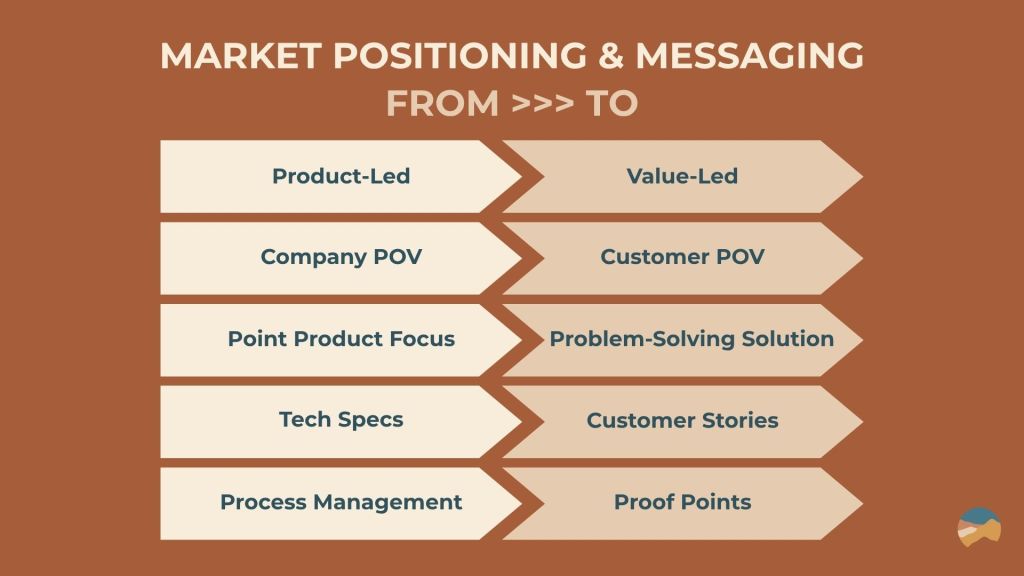
Here’s how I would shift that market positioning, so you have a consistent, relevant, and trust-building narrative that is rooted in outcomes:
You’re Saying the Wrong Things to the Right Market
Most European B2B tech companies default to feature-led messaging. The narrative focuses on what the product does, how it works, and why the technology is impressive.
When you are going to market with a focus on technical features, you are pitting yourself against the competition’s features as well as the pre-conceived opinions on that technology of the buyer. This is one of the most competitively challenged positions to place yourself in, especially in oversaturated markets, such as cybersecurity and data management.
This is also where you attract the attention of end users more, if not exclusively, instead of the entirety of the buying group. In a buying group of 10-12 stakeholders, only a fraction cares about the technical depth. The rest are evaluating impact, such as:
- What will this change for our business?
- What risk does it remove?
- What outcome does it enable?
When your messaging stays feature-led, you narrow your relevance to end users and unintentionally exclude the majority of the buying group.
From a marketing engine perspective, a direct consequence of this is the overemphasis on ‘bottom-of-funnel’ metrics, such as demo registrations and views. The further structural implications of this are operating models, KPI structures, resource planning, talent management, and internal misalignment. It might set you up for right now, but it is not sustainable, scalable or in support of the growth vision of the company.
When you instead elevate the positioning to value-led, the focus shifts to the value and benefits that the technology provides the customer. You present them with a clear view of what they can do, become, and a vision of what they can accomplish.
This is how you open up your market positioning to a level of storytelling that includes various versions of the same story, but this time you are engaging the entire buying group, placing you in a strong position to scale consistency across multiple markets, cultures, and buying behaviours.
This changes the base of your customer conversations to outcomes and successes, not features and prices. And it influences your operating model to be revenue and outcome-driven.
Your Value Is Framed From the Wrong Point of View
Even when companies attempt to elevate their messaging, they often do so from their own perspective:
- What makes the product unique
- What differentiates the technology
- Why the company is better
It is standard practice, though not recommended, to lead with the POV of your technology, focusing on what it can do and how innovative it is. But in today’s highly competitive landscape, many of your direct and indirect competitors are having similar messaging.
B2B technology buyers are overwhelmed with figuring out what’s working and what’s necessary for them to be successful in their role. Adding the content exposure they face, which is at an all-time high, you are not positioning yourself strongly in the market by ‘fitting in’ in the competitive landscape, and speaking from your technology’s POV.
Your buyers don’t evaluate from your perspective; they evaluate from theirs.
So you need to shift your entire POV to that of the customer. If your positioning isn’t anchored in:
- Their priorities
- Their pressures
- Their definition of success
…you’re forcing them to do the translation work.
In a market where they each are dealing with 80+ technology vendors, they simply won’t. This means they end up shortlisting companies they already know and trust, not the scale-up that can solve the problem better, at a lower cost, and with higher reliability.
Very few start-ups and scale-ups leverage this approach, so when you show them that you know them intimately, that you understand their challenges, priorities, and struggles, you gain a significant competitive advantage. They will trust you. And they will shortlist you.
You’re Selling Products Instead of Solving Problems
Feature-led messaging and company-led positioning naturally lead to point product thinking. You present individual capabilities, individual tools, and individual use cases.
I’m not saying that datasheets and tech specs don’t have a place; they absolutely do. But while we are shifting the positioning to problem-solving solution, the tech specs are going to take a back seat. Because your buyers are not looking for more tools, they are trying to solve complex, multi-layered problems across teams and functions.
That is why the positioning of your company and its products needs to reflect the unified benefits of its combined product suite, and explicitly state why it exists and what problems it solves.
Move on from competing on features and price, getting stuck in technical evaluations, and being excluded from the broader strategic conversations your customers are having. The big technology giants of our time are all doing this – and they are winning the market, even when the price point is higher, and the technology is more complex.
Your Go-To-Market Reinforces the Wrong Narrative
When positioning and messaging are misaligned with growth strategies, the impact compounds operationally:
- Marketing optimises for demo conversions instead of market education
- Sales conversations stay product-centric
- Content focuses on specs instead of proof
- KPIs reinforce short-term, bottom-funnel behaviour
It moves the issue from being a positioning and messaging issue to an operational growth constraint. This is also why it becomes so expensive to fix later, and why it requires much more capital to grow out of.
A key element to unlocking this narrative evolution is focusing on proof points instead of technical features and processes. When in a saturated market, proof scales trust faster than process ever will. And one of the greatest ways to accelerate this trust-building is through customer stories, external validation, and impact metrics.
What needs to be front and centre and lead the discovery of your company for new customers to find their way to you, for them to understand what you can do for them, and help educate the entire buying group, you need the voices and stories of your customers.
People buy from people who are similar to them. They build trust when they see their peers have made similar decisions and achieved what they are hoping to achieve. Focus on proof points, substantiated data and lived customer experiences that build undisputed evidence of the importance, relevance, and impact your company has.
Tech specs are static, but customer stories are full of contextual relevance. And in today’s market, contextual relevance rules.
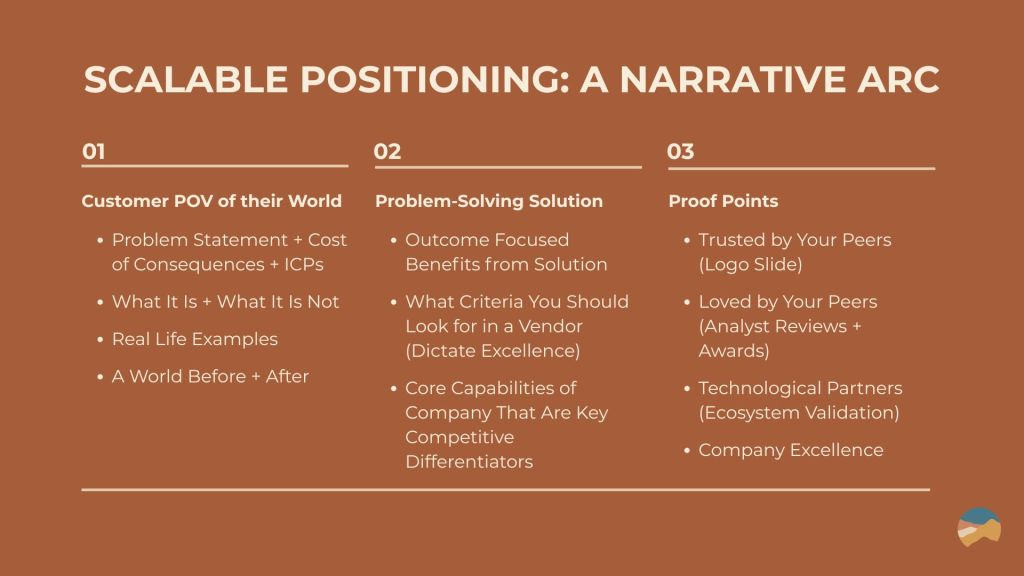
A Simple Framework for Scalable Positioning
In a more structured way, you can build out your compelling and convincing market positioning and messaging in the following way:
International Scale Is Not a Phase, It’s a Design Choice
European start-ups and scale-ups can absolutely realise their ambitions and become the leading technology giants globally. There is no lack of innovation, talent, ambition, or support systems. But where we do fall short on the global competitive scene is where, and how, we start.
When positioning, messaging, and go-to-market structures are built for local success first, they become increasingly difficult to evolve into something that can support international scale later. What begins as a practical, efficient way to win early traction becomes a structural constraint on growth. And by the time this becomes visible, when growth slows, new markets don’t convert, and expansion costs spike, it’s already expensive to fix, often too expensive to fix at all.
The companies that scale globally don’t solve this later; they design for it from day one.
They build positioning that can travel across borders and markets easily. They communicate value in a way that resonates across the entire buying group, and they anchor the success of their customers and their growth in proof, outcomes, and customer relevance, not product features.
That is what allows them to enter new markets with momentum, not friction. This is what gives them access to the growth opportunities that build technological giants.
There is no reason why European tech companies cannot move the same way, with everything that constitutes European excellence.
It starts with how you position your company from day one.
Through Momentum Marketing, I act as a Fractional CMO and advisor to AI and SaaS start-ups and scale-ups. I help you build and launch revenue-driving go-to-market strategies that deliver ROI within 90 days, and keep you scaling for 12+ months. Book a strategy call with me today to learn how.







 Momentum Marketing