
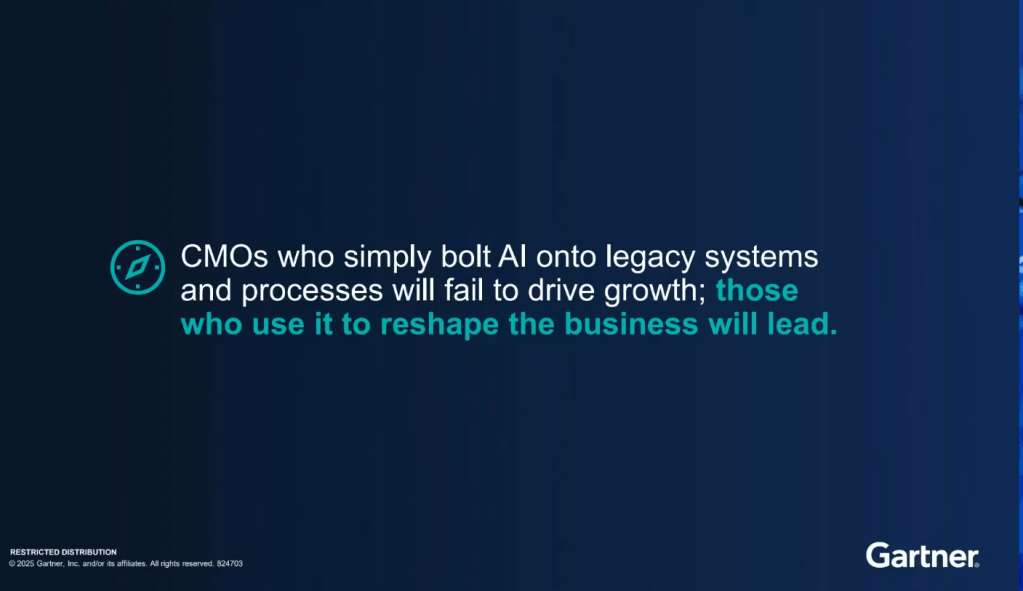
One of the most striking points from The Gartner 2026 Leadership Vision for CMOs session was the idea that we have officially entered an era where there is no marketing without AI. The CMOs who will win in the coming years are the ones who learn how to build truly AI-native marketing organisations, not by adding AI tools on top of legacy operations, but by rebuilding workflows, decision-making processes, and content strategies around what AI makes possible.
Despite AI’s power, it does not replace the fundamentals of strategy. What it does is change the entire dynamics of content consumption, customer experience, engagement, and distribution. We’re living in a period of unprecedented content volume and accessibility. AI has multiplied content production across industries, which means the old playbooks are losing effectiveness.
Standing out no longer comes from producing more, but it comes from producing meaningfully, with intentional personalisation and narrative relevance anchored in the customer’s reality.
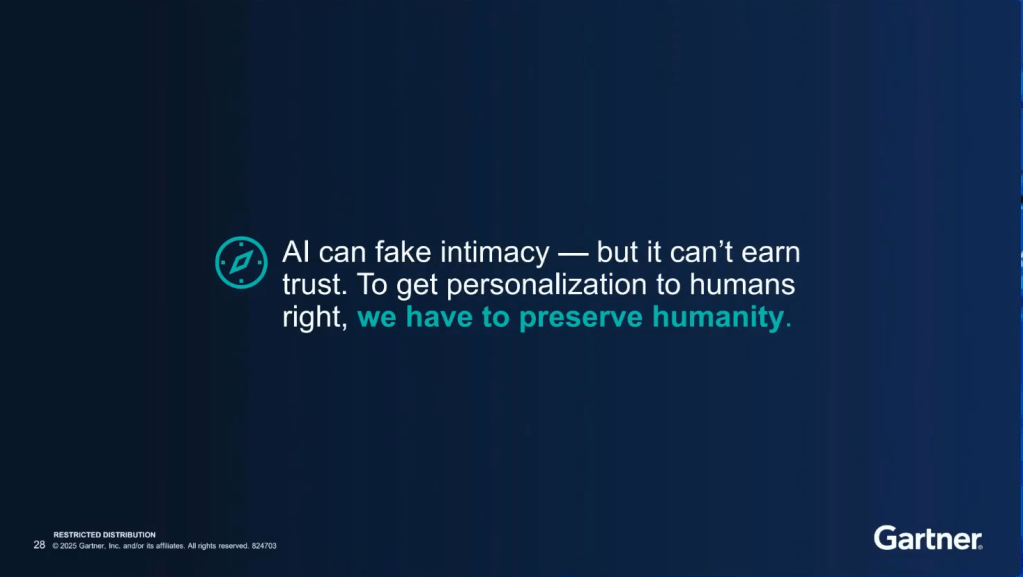
The need for thoughtful personalisation has never been higher. AI can automate intimacy, but it cannot earn trust, and trust is fast becoming the most valuable currency for any business.
Who Owns AI In An Organisation?
Another important shift highlighted in the session was around ownership.
Many organisations are still debating who “owns” AI; is it marketing or is it IT? Gartner’s perspective was clear: both do, but in different ways. Marketing owns experimentation, pilot projects, outputs, and the ROI story. IT owns the infrastructure, governance, data centralisation, and safeguards. Successful AI adoption will require a deep partnership between these two functions, not territorial boundaries.
An audience member asked a terrific question: How do you get started with AI in organisations that are either heavily dedicated to their current processes and workflows or heavily regulated, with AI usage posing a greater risk?
For organisations where AI adoption is slow or heavily regulated,Gartner shared some practical patterns from successful CMOs;
- Many begin with internal, low-risk trials that deliberately avoid proprietary data.
- Some frame their experimentation as a “permission to explore” request backed by the argument that marketing teams typically handle low-sensitivity data while offering extremely high ROI potential.
- Others lead with strong business cases focused on time and resource reduction, one of the most compelling proof points for AI in any function. When CMOs can quantify how AI eliminates manual work, from reporting to analysis to content operations, it becomes much easier to secure wider executive support.
An Immediate Need for Mindset Shift
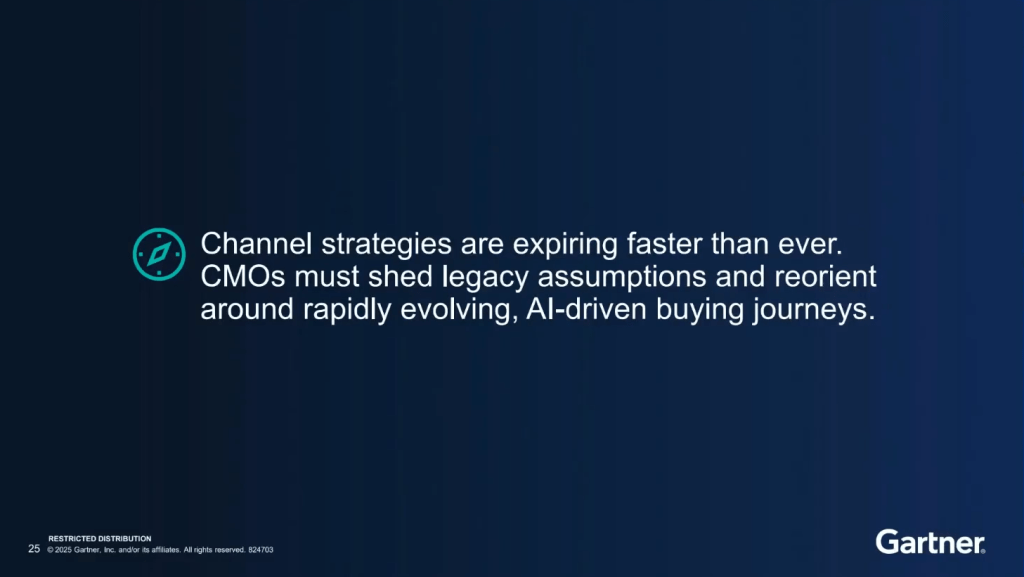
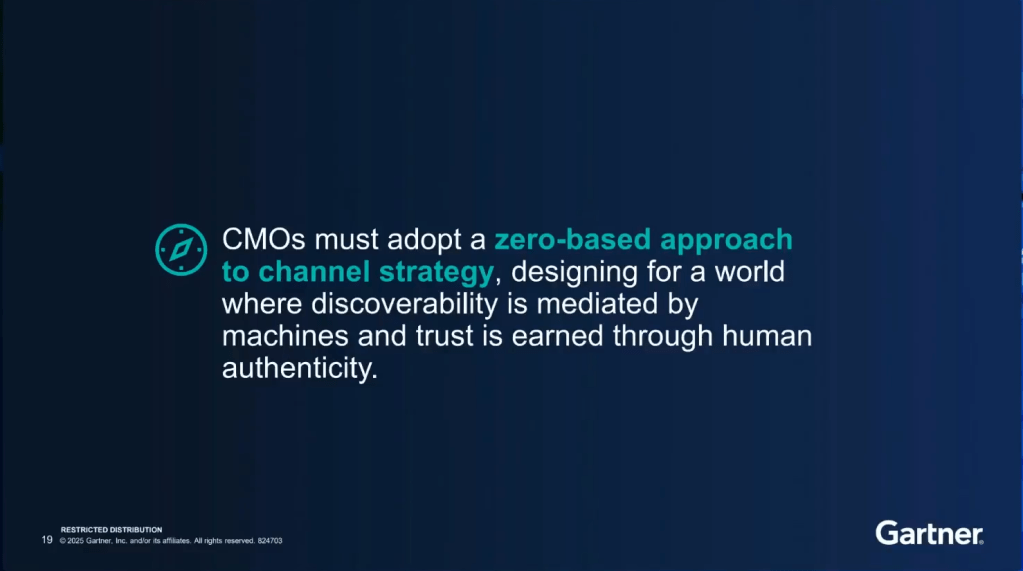
One of the biggest mindset shifts Gartner recommends is adopting a zero-base mentality for channel planning. Because AI agents and AI-driven search behaviour are accelerating so quickly, last year’s successful channels may not be next quarter’s best bets.
Gartner is now advising CMOs to assume that no channel automatically deserves continued budget and to re-justify channel investments every quarter, not annually, and not based on past performance, but based on forward-looking projections.
With AI chatbots and AI-driven search experiencing exponential traffic growth, distribution is shifting faster than most organisations expect.
Trust Built On Transparency, Not Efficiency
And through all of this change, trust becomes the centre. AI can simulate connection, automate relevance, and mimic personality, but it cannot build the emotional confidence that customers place in brands. As AI takes over more executional work, the role of marketing teams becomes increasingly focused on humanity, authenticity, storytelling, and transparent communication. The brands that keep their human essence intact will be the ones that stand out in a world of AI-generated sameness.
How the CMO Role Is Changing & What CEOs and CFOs Now Expect
The CMO role is undergoing one of its most significant transformations in the last decade. The insights from ‘The Gartner 2026 Leadership Vision for CMOs‘ session made this especially clear: marketing leaders are no longer defined by branding, campaigns, or pipeline creation alone. They are stepping into enterprise-level transformation roles that deeply influence how organisations modernise, adopt AI, build trust with customers, and operationalise growth.
The CMO has become one of the central forces in shaping how companies compete in an AI-enabled world.
One of the biggest shifts is the expectation that CMOs will act as organisational change leaders. Gartner emphasised that AI transformation is not an innovation project; it is a change management initiative.
And like any transformation, it requires clear expectations, measurable outcomes, training programmes, new capabilities, and strong cross-functional alignment. CMOs are now expected to architect this journey, not simply react to it. This elevates the role from a function-specific leader to a company-wide shaper of capability and culture.
A major part of this transformation is the rapid upskilling of marketing teams. Gartner noted that top CMOs are investing heavily — right now — in AI training, both internal and external. They are creating internal knowledge centres so that new learnings can be easily shared, especially around company-specific agents and AI workflow tools. They are partnering with external learning platforms to keep pace with the speed of AI innovation. More importantly, they are embedding constant experimentation into the culture.
For CEOs, this signals an organisation that is ready for the next phase of growth. For CFOs, it signals controlled, intentional innovation rather than unstructured experimentation.
The Nature Of Forecasting Asks Are Changing
In an AI-powered organisation, CFOs are starting to ask marketing to justify channel budgets quarterly, not annually, and to rely on future projections rather than historical performance. With the rapid development of AI tools and changes in buying behaviours, marketing can no longer rely on historical data for future performance projections.
Here, Gartner recommends CMOs to adopt a zero-base mentality for budget planning, every quarter, not annually. CFOs are asking for clear ROI stories around AI investments and their outcomes. They want simplification rather than tool sprawl, and they are increasingly expecting CMOs to bring forward plans for how AI will reduce repetitive work, lower operating costs, and accelerate decision-making.
In other words, growth is not enough. The modern CMO must show a balanced story of efficiency, effectiveness, and risk reduction.
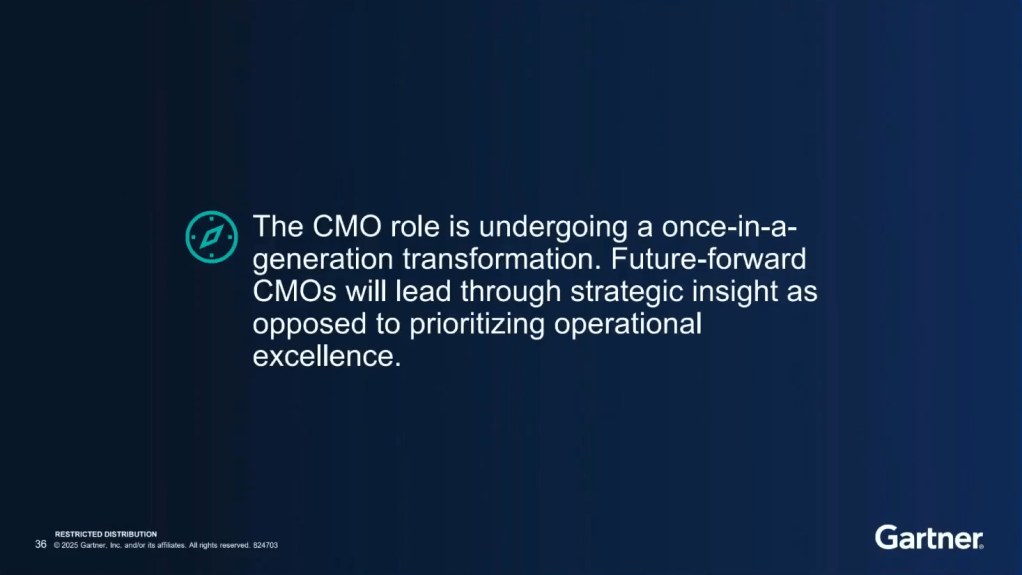
Meanwhile, CEOs are actively looking for CMOs who can unify strategy, customer experience, revenue alignment, and organisational readiness. They want leaders who can articulate a clear point of view on where AI should be embedded, how brand trust should be strengthened, and what the company’s competitive advantage looks like in a landscape where technology is reshaping every department. They want CMOs who understand hypergrowth motions but who can also be grounded, pragmatic operators capable of leading through uncertainty.
All of this means that the CMO of 2026 is becoming one of the most strategically important leaders in the executive team.
They are the connector between growth and innovation, the integrator between marketing and technology, and the leader who ensures the organisation keeps evolving at the speed of the market. It’s a more complex role, a more influential role, and ultimately a more exciting one.
The CMO’s Expanding Role in Customer Engagement & The Key Initiatives That Build Trust
One of the most compelling points from The Gartner 2026 Leadership Vision for CMOs session was the shift of customer engagement and experience under the CMO function. Traditionally, many organisations placed customer experience under customer success or operations, but Gartner predicts that in the next two to three years, this responsibility will increasingly sit with marketing.
This reflects a much larger trend: the journey from initial awareness to long-term value is becoming more interconnected, and customers expect that same continuity from the businesses they engage with.
The CMO is now positioned at the centre of that relationship.
AI has completely rewritten what customer engagement looks like. With AI generating more content, more recommendations, and more automated micro-interactions across touchpoints, customers are encountering brands in ways that are both more frequent and more fragmented.
That means CMOs must build journeys that feel cohesive, intentional, and human, not algorithmically random. Personalisation must evolve beyond simple targeting and into contextual, emotionally intelligent communication. This requires a deeper understanding of customer intent, more thoughtful content design, and a commitment to building trust in an environment where automation dominates.
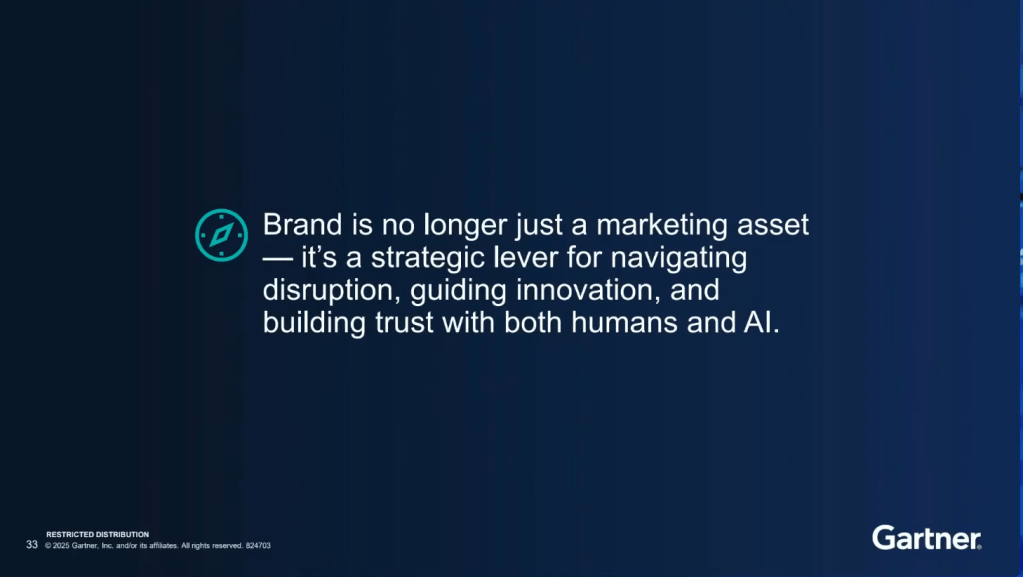
Trust is the anchor point. Gartner made an important distinction: AI can fake intimacy, simulate empathy, and generate personalised content at scale, but it cannot earn trust. Only humans can do that.
This means marketing organisations must lean into storytelling, transparency, and brand character more strongly than ever before.
As AI takes over more executional work, brands that cling to generic AI-created messaging will sound increasingly similar. The differentiation will come from the authenticity and clarity of the brand’s human point of view.
This shift also influences how companies design their digital experiences. Many CMOs are already using AI engine optimisation trends (AIO) as a reason to re-architect their websites.
Instead of treating websites as static collections of content, they’re reorganising them to support intentional customer journeys and AI-driven discovery.
This means indexing differently, restructuring navigation, and designing flows that guide customers step-by-step rather than relying on them to self-navigate. Learning content remains powerful, but only when deeply aligned with the ICP’s needs and delivered in formats that reflect how discovery is changing.
Because of these new dynamics, several initiatives are emerging as critical priorities for CMOs:
- CMOs need to build customer journeys that balance efficiency with empathy, using AI for relevance while preserving humanity.
- CMOs need to continuously re-evaluate distribution channels and touchpoints through quarterly zero-base thinking and planning, ensuring that the organisation isn’t relying on outdated assumptions about how customers find information.
- And most importantly, CMOs need to take ownership of customer trust, not through slogans, but through consistent actions, transparency, and meaningful communication across the entire lifecycle.
As customer expectations rise and AI amplifies the volume of digital interactions, the CMO’s role becomes less about managing communications and more about shaping relationships.
The brands that succeed in 2026 and beyond will be the ones that understand this shift and build engagement models grounded in trust, authenticity, and purpose-driven experience design. And for CMOs, this expanded responsibility represents not only a new challenge but a profound opportunity to shape how companies connect with customers in the AI era.
I highly encourage you to watch the full The Gartner 2026 Leadership Vision for CMOs webinar for many more insights, stats, and recommendations from real life CMOs and their advisory boards.
Disclaimers: No, I am not affiliated with Gartner in any way. I just really enjoyed this session. This write-up is purely for my own pleasure, and hopefully also yours. This is partially written using AI support, based entirely and exclusively on my own notes.
Through Momentum Marketing, I act as a Fractional CMO and advisor to AI and SaaS start-ups and scale-ups. I help you build and launch revenue-driving go-to-market strategies that deliver ROI within 90 days, and keep you scaling for 12+ months. Book a strategy call with me today to learn how.

 Momentum Marketing