
No doubt we are in a time of transformation on all fronts, so when Informa TechTarget asked me to join them for a discussion on where we believe B2B tech marketing and sales are headed in 2026, there were hours worth of debate and discussions to be had. Our challenge was “How do we get all of these transformations and predictions for 2026 distilled down to one hour, one conversation, and still keep it high quality?”
Byrony Seifert, Head of Scale Products at Informa TechTarget, had the solution: we root it in survey data from European marketers and identify the top seven predictions for the year ahead. This wasn’t the only brilliant idea Byrony had – she also put together a group of people, myself included, who all work in B2B tech marketing and sales, but from very different angles and perspectives. And this made this one conversation that much more intriguing!
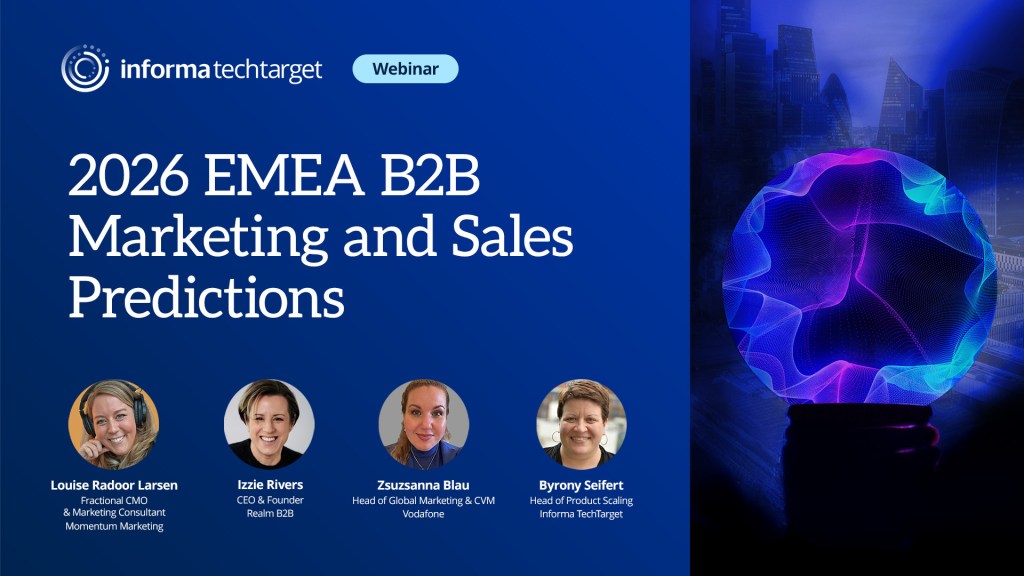
You can watch the full conversation here and skip reading ahead if you prefer listening/viewing.
Or, continue reading and get my take on those seven predictions. Granted, you gain more viewpoints, perspectives, and input from watching our conversation, while if you decide to continue reading, you will gain more in-depth POVs from my side.
2026 Outlook For B2B Tech Marketing & Sales Teams
The following data points are kindly provided by Informa TechTarget, and originate from research conducted of 109 EMEA Marketers from December 2025, by Informa TechTarget, on EMEA B2B marketers’ direction for 2026, and what they are doing for marketing planning.
In a nutshell, four key themes emerged from the research, illustrating the EMEA marketing landscape in 2026:
- AI investment is accelerating
- Nearly 2/3rd of EMEA marketers plan to increase spending on AI and automation.
- Meanwhile, non-AI marketing tech budgets remain flat or decline.
- AI is the clear priority for driving growth and efficiency.
- Marketers face pressure to do more with less
- 60% cite budget constraints as a top challenge.
- Teams are prioritizing tools (like AI) that boost efficiency and scale, rather than expanding overall spend.
- Content needs to be quality-focused
- 62% cite that their top content priority is to produce more effective content.
- Content formats have shifted away from traditional…. Case studies, in-person experience, testimonial videos, and social media.
- Focus is on results, not just technology
- Top priorities: lead quality, buyer engagement, and content effectiveness.
- AI and automation are being adopted to deliver measurable impact, not just for experimentation.
7 Predictions for B2B Marketing and Sales in EMEA, and where I believe they’ll show up
Prediction 1: AI Investment Outpacing Trust in AI
65% of teams are increasing their AI spend in 2026, but almost the same proportion state that they distrust AI-generated or AI-assisted content.
Will the AI investments yield the desired results in 2026? Are there success stories and pitfalls to look out for? Let’s get into it!
It depends! A most favorite and inconclusive opening statement, but allow me to explain. It does depend on how you invest and what goals you have for business growth.
For example, if your goal is to lower cost/increase cost efficiency by increasing output and having that as one of your primary KPIs for the investment, then I believe you are not going to see the results you are looking for. Instead, you’ll risk eroding brand trust externally, while internally you’ll be focused on “doing more of the same” instead of leveraging AI as the transformative force that it is. In my opinion, this is a short-sighted and limited way of thinking about AI applications.
The great successes are found in the revenue leaders that understand how to create deeply personalized, consistent, and thoughtful customer experiences, from the very first engagement, that make it easier to get the “yes” from your customers and partners. This is where you will unlock huge upside and opportunities. The thinking in this scenario is a lot bigger, more transformative, and it requires a fundamentally different operating model, fueled by strong change management leadership.
All of these things we’ll dip into on and off as we go through the predictions one by one.
And got asked a question about this prediction: What are your feelings about AI-generated content?
Oh, do I have many feelings on this topic 🙂 But for the sake of sanity, let’s look at it from this angle: I think it’s a spectrum that both entails quantity vs. quality and, at the same time, AI-generated vs. AI-supported. This is where I see us marketers and salespeople are at, here at the beginning of 2026.
On one end of the spectrum, you have this objective: If you are looking to create a lot of content, and you decide to do it 100 % through simple or advanced AI prompts, you get undifferentiated, low-quality/high-quantity content that creates more noise and confusion than attention and credibility. We are seeing this in the market, mainly because this modus operandi requires very little effort, not a lot of experience, and minimal strategic thinking. What it does provide you with is a high quantity of content that is 100 % AI-generated and based on AI sources. It can be a solid building block for teams that have little to no marketing resources in the short-term. Long-term, you are looking at credibility, trust, and ranking issues.
On the other end of the spectrum, you probably have this objective: You want to leverage your internal data, your own subject matter experts, industry reports, market research, and, in general, verified sources of data and information relevant to your target audiences and line of business. You feed this information, as the sole source, to your AI content generator tool. Now, you are looking at AI-supported content in much higher quality that provides a clear, consistent, and differentiated point-of-view that your target audiences can mirror themselves in.
This helps you build your credibility and trust over time.
This approach requires thoughtful and strategic experience and effort, on top of a skillset that understands your target audiences deeply AND knows how to get the AI tools to bring your content to life in the tone and voice of your company.
At this point in time, it’s a spectrum, and I’m personally leaning towards AI-supported content vs. AI-generated content. I’m also extremely curious to see where all of the AI content tools have taken us a year from now.
I was then asked the following question: What are the implications of pushing for usage beyond how much the teams are ready to accept this direction?
Let me start with this hard truth: You get on the train, or you’ll be left at the station.
That being said, AI is a huge transformative force, and it is very exciting to see how it makes us capable of realising the ideas and visions we have had for years, but haven’t been able to bring to life due to a lack of resources and bandwidth.
Now, for revenue leaders, there is a new big responsibility here, which is to lead your teams through this transformation. Your new job focus is change management, facilitating curiosity, learning, and ownership throughout. The master key to any large-scale transformation is making people feel like they have ownership of the process and change. The teams I see are having the most success with rapid AI-adaption are the teams that have been split into smaller sprint or mini-project teams, each tasked with testing and trying out a different AI area; for example, campaign roll-outs, sales engagement recommendations based on buying behaviour signals, personalization, partner marketing activation, etc.
When you lead your teams with a focus on curiosity and ownership, the process goes a whole lot smoother. The level of AI-adaption is a leadership responsibility, and it is a true test of change management skills.
Every company is going to use/implement AI in its own way to serve its own goals. Much like we saw it with cloud adaptation, or any other type of technology that now appears ‘legacy’. We’re going to see multiple hybrid models form throughout 2026 and beyond.
Prediction 2: Marketers are Navigating Declining to Flat Budgets Amid Rising Execution Challenges
80% of budgets are flat to decreasing for marketers in 2026. Declining funnel-metrics aross the board and a myriad of competing priorities are some of the many new challenges to budgeting this year.
We are all experiencing budget planning challenges for 2026, and trying to solve the puzzle of doing way more with way less is definitely a headache many are trying to find relief for.
I see and experience a lot of conflicting intentions and ideas behind these budget cuts that are being made. What I hear and notice a lot is that budgets are cut, the team’s scope of work increases, and/or is being split up into new functions, or downsized. Yet, the operating KPI model continues to focus on volume and quantity in leads, touches, outreach activities, and emphasis is placed on funnel-metrics. All this adds up to a level of internal pressure that continues to build, to a point where the steam lid is going to blow off with a big bang.
Whereas when leadership is more open to a KPI model that favors, for example, excellence in customer experience, shortening the sales cycle, minimizing the number of sales engagements, and reducing the cost per opportunity generated, etc., you are able to align these budget cuts to bigger wins.
Follow-up question on this: What are some of the competing budget priorities in the EMEA market for 2026?
This is an excellent question to ask, because the competing priorities are as plentiful as the diversity of the entire EMEA (Europe, Middle East, and Africa) market.
An example I’ve seen is trying to make priorities across the region with a one-size-fits-all approach, where global (US) tech companies pull their entire field marketing and strategic events budgets in favor of an all-in on digital marketing. This lasts about 1-2 quarters at most before they reverse their priorities, because the negative financial impact of not having a country/market-specific marketing mix will put you in the red.
Across EMEA, you have 100s of countries with their own business culture and market maturity. A one-size-fits-all approach won’t yield the returns you are looking for.
The challenges of understanding local markets and what works best in each culture is a challenge that has been around since business started going international. It is still a cause for many struggles and competing priorities for global businesses.
At any time, budget priorities need to be tied to both business goals and market fit. Maybe now, with the added pressure from budget cuts, this is something that can present itself as a solution?
Prediction 3: Content Relevance will Drive Results in 2026
There is a massive shift happening in the content used and its placement to achieve relevance. High-impact content alongside reach factors equals a new path that has formed for marketers.
There is indeed a huge relevance shift happening. The shift is indicated to happen due to the change in behaviours and the nature of buyers.
Millennials are now the largest demographic amongst buyers. “Desk research” or content consumption before even reaching out to a vendor is at an all-time high, with +12 pieces of content consumed ahead of direct engagement. Trust is at an all-time low, while information is overwhelming a lot of buyers, and scepticism is instant when authenticity is lacking.
Had you built your content strategy around your ICP (ideal customer profile) needs and wants first, your values 2nd, and your business goals 3rd, you would be ahead now. If not, you are catching up.
You become relevant when you speak to your ICPs needs and wants, mirroring their challenges and successes back to them, through your own competency and POV (point-of-view).
You are authentic when everything you communicate is rooted in your company’s values and identity – every company is as unique as a fingerprint – and, when you consistently show up that way, you build a trusted relationship with your audiences.
The third point here is business goals – and please do note here, at no point am I talking products, features, or tech specs. Your technical content is also relevant, but your content should serve your business goals consistently and show up with intention.
But content is expensive and hard to create. How do you balance relevance to drive the right results vs. getting enough content into the market to tell the message?
A really easy, quick–win to create highly relevant content is by using AI, for example, AI agents! You can custom-build an AI-agent that scrapes through your CRM, customer-facing call transcripts, and customer support tickets to help you identify:
- Customer needs and wants
- Customer challenges (internally as well as externally in their organization)
- Convincing content for the entire buyer’s team
- Competitive complaints
- Success stories, quick-wins, and transformative stories
- Troubleshooting guides
- Market research and insights
- How and where they consume content
- … and so much more!
You plot this data into your AI tools, and it will help you build out a highly ICP relevant content calendar that converts. Today, all of this can be automated and auto-generated with low-cost AI tools, provided you bring a strong content strategy and focus to guide it in the right direction.
(Side note: I would recommend watching/listening to this ExitFive podcast for two examples on this.)
Now, while doing so, don’t forget to leverage the core principles of omnichannel marketing. This marketing mindset isn’t going anywhere; if anything, it needs a more central spot in your marketing strategy. Using the core principles of omnichannel marketing helps you ensure a consistent and seamless customer experience, wherever your customers meet you. If they only see you in one way in one place, for example, a LinkedIn ad, they won’t remember you or your messaging. Their experience of you needs to be consistent, and ICP focused across all channels, at the same time.
And, I cannot stress this enough, personal branding is a must! Every company needs, at a minimum, a small army of people with a strong personal brand. Whether this is chronicling on Substack, posting on LinkedIn, hosting their own podcast, or talking things through on YouTube, your business needs people who do one or more of these. Please don’t sleep on this.
Prediction 4: Channels need to Build Credibility and Scale
Credibility is more important than ever, but the scale of demand versus brand alignment equals different paths of content placement. How do you balance both and get some much-needed crossover?
First, a little note of concern, as I do hope demand and brand aren’t generally considered two different areas. Your brand should, ideally, be a consistent part of every single interaction anyone will have with your business, across all types of content, placements, and engagements.
Your brand is, visually and experienced by your customers, the one thing that should always be a constant to build the credibility and trust that will help you scale. (See an example of this here)
While this, historically, is a huge challenge (and many of us have been through various evolutions of intranets to try and create this consistency), in the age of AI – we should be very able to solve this challenge now.
Whether you build an AI-automation agent in-house or you purchase it as a ready-made tool, you have the full power, capability, and resources to make this happen now. And not only between demand generation and brand, but across the organization from Marketing to Sales to Finance to Board to Investors, etc.
Cost-efficient AI tools exist for this now. And they are capable of multiplying a brand campaign into demand generation assets of all types and formats, such as media banners, website designs, any type of collateral, presentations, sales assets, partners, all of it!
Speaking of partners: Partner marketing is ranking high in importance, higher than ever. So how do you approach partner marketing now?
- I think partner marketing is ranking the highest ever because around 70 % of global IT spend runs through partners, and
- with budget cuts in marketing spend at IT vendors, partner marketing is where the more cost-efficient growth happens.
One of the challenges here, however, is that often your partners have little to no marketing resources themselves, and it therefore often can take up to several quarters before a partner has rolled out your latest campaign. And, sometimes, they are even running legacy campaigns of yours, while you are on to the next big brand campaign. This creates inconsistency in the market and even confusion amongst your customers.
Now, there are several very promising AI-native companies in the market today that solve this exact problem. Imagine now, through AI tools, your partners are rolling out your latest global campaign just 48 hours after you launched? It’s unheard of! But this is another ailment AI is helping us solve, and yet another thing we can cross off our frustrations list. We’ll get new frustrations, but for many of us, this one has lasted for decades. Time to retire it.
There are huge upsides to spending some of that AI budget on this area. Start investigating and investing in how to automate this with your partners, both on the marketing and sales side, and you’ll see gains coming in faster.
Prediction 5: Personalization Pays Off When Content Converts
Personalization is a strategy enabled by technology, but content quality and consistency are critical to ensure those efforts actually convert. How do you feel about this prediction and the direction that personalization is taking for effective demand generation?
To me, I firmly believe personalization should be the core of your customer experience strategy, deeply rooted in your ICPs’ needs and wants. Speaking to your ICPs at a level where they feel seen, listened to, and understood means they will invest their scarce resources and time with you.
A whole next level of this, I imagine, is when we can begin to personalize with an AI-guide that shows your visitors around. Let’s take your website as an example; today, you have a chatbot that can give you short, limited options and answers. I imagine an AI-guide – picture yourself on a city walking tour, where you are following your guide with the red umbrella – being able to do that for your website visitors. Entirely personalized engagements based on previous website visiting behaviours, your AI-guide offers a few clarifying questions to the visitor to identify the optimal “tour route” for them. Along the tour, the AI-guide feeds them with “others like you have asked us about this – do you feel the same?”
Another example of an AI-guide could be your potential customer coming to your website, asking your AI-guide, “Hey, I’m with company X, and I’m about to present your solution to my CFO. Can you build me 1-3 slides that show why we should choose you and how the investment can be justified for us?”
That level of personalization makes every step of the process easier for your ICPs to reach a yes. Not to mention the cost-efficiency of that level of engagement. Just a thought I had, and something I’ve been talking to webteams about lately. If anyone out there is building this, let me know!
Follow-up question on this topic: What are strategies in the market that are working here, related to content quality? And why is execution where the purpose falls?
Execution is where it falls, I believe, because the technology hasn’t been fully available, invested in, or prioritized yet. The tools are widely available, and even more now with AI on the scene, yet somehow, this has been put on the back burner time and time again.
Where I see it work really well today is in 1:few ABM campaigns and with some event managers. I know both ABM and event marketing managers who master this to a T, but it is – in my personal experience – highly dependent on the person behind the marketing function, more than the function itself. Which makes it hard to scale, to replicate, and it makes it hard to get the necessary resources to sustain it, especially when KPI models favor funnel metrics over customer experience.
I also see it work really well on the sales side, in particular with AEs (account executives) who understand the concept of being the CEO of the customer relationship. When they take the reins and orchestrate a personalized engagement experience across all functions, that is one of the most exciting things to see and experience!
An element here, where AI can help, is assisting the AE with follow-up content recommendations based on conversational topics pulled from transcripts. That is also a huge role marketing can play and lead in here, to help shorten the sales cycle.
Prediction 6: Marketers are Balancing Speed with Market Differentiation
You need better audience targeting while implementing AI ASAP and getting sales what they need faster and more effectively, but you have less budget, and everyone is taking 6 more months to buy. How do we survive?
- You survive by staying consistent, trustworthy, reliable, and relevant.
- You get better at understanding your ICPs’ needs and wants by deep-dive analysing your customer data, transcripts, buyers’ journey engagements, and more, through AI-enabled analysis. This will improve your audience targeting AND messaging.
- If you want to do this cost-effectively, start by studying the AI start-ups that hit $100M ARR in less than a year with next to no marketing budget. They build growth through two important gateways;
- Community: And while community is something we, historically, have looked at as a separate thing, mainly for user groups and highly technical folks, these AI companies are building growth through word of mouth. Actually, let me rename it: it’s not community, it’s fandom. The Taylor Swift type of fandom. And that fuels growth superfast and very cost-efficiently.
- Self-service: These AI companies have transparent pricing structures, self-check-outs, and some customers don’t even have an actual salesperson engagement.
- Community: And while community is something we, historically, have looked at as a separate thing, mainly for user groups and highly technical folks, these AI companies are building growth through word of mouth. Actually, let me rename it: it’s not community, it’s fandom. The Taylor Swift type of fandom. And that fuels growth superfast and very cost-efficiently.
What lessons can be learned from these AI start-ups, and their buyer’s behaviours? How could you mimic or recreate that at your company? That’s not only how you survive, but thrive! (If you ask me.)
(Here’s a sneak peek into how Gamma did this.)
New Q: GEO and SEO are changing rapidly. What are you seeing here, and how is this affecting the content strategy in the market?
- Yes, and there is definitely a lot more market complexity here, mainly because target audience behaviors have changed so much, AND depending on your market and demographics, each group operates and engages differently on different digital platforms. As a marketer today, you need a lot more research and understanding of your individual ICPs + market culture + platform behaviors.
- The revival of your press releases! One thing we need to mention here, too, is AEO. And it turns out, both your press releases and your media coverage now play a huge role in rankings and algorithm credibility. Hail your communications people, and don’t forget to include them in your content marketing strategy.
- Personal branding! I’ve mentioned this one before (and will mention it again, and again, and again), but this one is hugely important. Put your best humans forward, and let people get to know them. It pays off more than you can imagine.
Prediction 7: Buyer Insights Drive Smarter Sales Conversations
Buying stage indicators, content topics engaged, and pain points in the research behaviour came out on top as the three key pushes that marketers feel will help them drive more effective sales in 2026.
What marketers believe will drive more effective sales conversations (top buyer insights)
- Buying stage indicators based on intent signals = 52%
- Specific content topics prospects have engaged with = 51%
- Identified pain points based on research behavior = 50%
- Buying group member composition, their roles, and recent activity = 39%
- Activity with competitors = 31%
- Technology stack information = 26%
I was asked: Do you agree with this list?
If you’ve read this far, you probably know what’s coming now. Thank you for reading it all the way to here. I appreciate you spending a moment of your time here. Now, my version of this list looks like this:
- Buying behaviours per ICP
- ICP needs and wants
- Buying group members and responsibilities
- ICP struggles and challenges
- Competitive complaints
- ICP content consumption places
Capturing this is as important as creating. Capturing reduces guesswork and deflating hit-and-miss content and engagements. When you systematically collect what your audience is asking, reacting to, and repeating, you:
- Increase relevance and resonance: Your content mirrors customer language and priorities.
- Accelerate sales cycles: Your content addresses real objections with precise proof.
- Strengthen positioning: Your content themes are anchored in live market signals, not internal opinion.
- Compound ROI: Just one captured insight fuels multiple assets (FAQ, post, talk track, ad hook).
This is why it is so important to capture first and create later. In doing so, you ensure that every piece of content, every marketing and sales asset is built on evidence, not assumptions.
This is how you break through the noise and engage directly with your ICPs. Simply put, shift the core question from “What should we push next?” to “What are they telling us right now?”
What do you think? What would your list look like? And what are your predictions for this year? Let me know in the comment section here!
Through Momentum Marketing, I act as a Fractional CMO and advisor to AI and SaaS start-ups and scale-ups. I help you build and launch revenue-driving go-to-market strategies that deliver ROI within 90 days, and keep you scaling for 12+ months. Book a strategy call with me today to learn how.

 Momentum Marketing