
Because in hyper-growth scale-up organisations, fastest to market is key to business success. There isn’t room or time for decision fatigue. The market is already moving. We have to be able to build the momentum to move with it.
We have to hit our targets, we need to optimise our processes, we have to leave room for experimentation, this trend would fit us so well, there are 1000s creative ways to solve this challenge, the team needs rest, the team needs motivation, our targets just got raised, we have to scale up, the favorite team member just resigned, our budget just got cut again, we need to build out a new function in-house, how did our competition do that, we need to shift gears and move everybody to our new GTM model…. And so on… The time for decision-making as a marketer is literally never ending.
When everything seems to be on the line all at once – and it feels like this one decision will make or break the success of our team, our business – the cliché goes: To be truly resilient in the face of adversity, you need to get comfortable being uncomfortable.
And here’s the thing about clichés – they mean something different to each of us. That’s what makes them a cliché! But this is also what makes them meaningless until you “get it”.
So, I found/concocted three effective decision-making methods that you and anyone else easily can lean on, each with its own use case depending on the size and impact of the decision’s expected outcome. Allow me to share these trusted methods with you here. First up, The Renovator’s Delight.
1. The Renovator’s Delight
The Renovator’s Delight is a theory I first came across years ago in a TEDx Talk named Embracing Change by Jason Clark, founder of Minds at Work in Australia. It is a powerful and highly inspiring 18 minute talk on change management and how to get people to “think again”. If you only have a few minutes to spare (though I would highly recommend giving yourself those 18 minutes to get inspired), watch the “The 4 Doors” and “Ownership” chapters on YouTube.
In short, Jason Clark mentions The 4 Doors perspective as: “You think about this idea of four doors. The first door are the things that we used to be able to do and can still do. Door number two are the things that we couldn’t do before and we still can’t do. Door number three are the things that we could do before and we can’t do now. Door number four are the things that we couldn’t do before but we can do now.”*
*Source: Jason Clarke on Embracing Change at TEDxPerth (Full Transcript)
This, as a change management and change communication tool is very very powerful. I have used it extensively when guiding leaders on how to communicate disruptive business changes, or when I have had to deliver the news myself. It works. Very well. It helps to create calmness, structure, and control in a chaotic situation, at small and large scale.
The ‘Ownership’ chapter directly speaks to the concept of The Renovator’s Delight. Say, if you were renovating your house, you would most likely ask yourself the following questions: What do you keep? What do you chuck? What do you change? What do you add? Simple questions that can help you decide rather quickly.
Now, when looking at this from a decision-making angle instead of change making, I tend to merge the two and morph the questions into a classic little model like this:
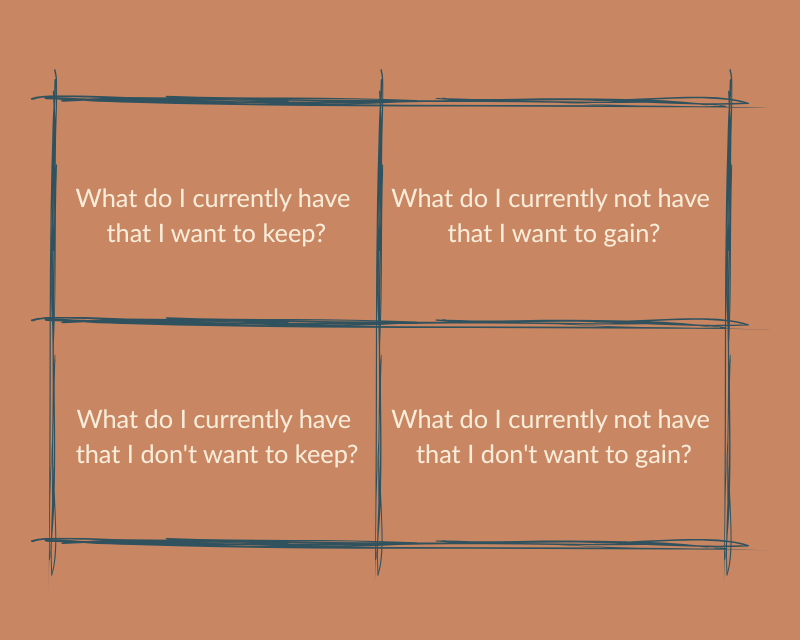
This decision-making model works really well for the big and strategic questions, for example: What should my life look like next year? The next five years? The next decade? What do we have to do to get to our business goal for the next three years? Next year? Next quarter? Next month?
What I find people, in general, are really good at answering are the top two questions: What do I currently have that I want to keep? What do I currently not have that I want to gain? These two are filled with aspirations, ideas, ambitions, ideals, safety, comfort, and preservation. Often, we have a pretty good idea of what this looks like, once prompted to think about it. But make sure you write it down – because when the full picture presents itself, so does your decision.
What can really make you think – and truly help you arrive at the right reasoning for your decision-making – are the bottom two questions. What do I currently have that I don’t want to keep? Meaning, what you have that you want / need to let go off, as they are currently not supporting your aspirations, ideas, ambitions, ideals, safety, comfort, and preservation. This can be an uncomfortable but very rewarding discovery. And it helps you shift your direction with determination and motivation.
The question that almost always gets overlooked is the simple but very effective question: What do I currently not have that I don’t want to gain? Do you know what you absolutely do not want to invite into the outcomes of your decision-making? Are you fully aware of what that looks like and why that is unwanted? The decision that you need to make will lead to a desired outcome that you are trying to achieve. Knowing exactly what you absolutely do not want to happen can help create guardrails and ensure blind spots are dealt with before they become a hindrance. If you wish to have maximum clarity on direction and confidence in your decision-making, this is the question that will help you gain that.
This framework has helped me out time and time again, in so many ways. You can use it for generating ideas, visions and change management as Jason Clarke spoke about, or as a tool to effectively communicate disruptive changes in your organisation, or – as I more often than not use it for, effective decision-making.
2. The Can, Will, Must Method
For larger decision-making, The Renovator’s Delight definitely has plentiful use cases. However, we are not always offered enough time to dig in, and sometimes the decision doesn’t need that level of thinking. We can make decisions on the fly with our gut telling us what feels right. This works well too – when you are good at listening to your body.
In the case you need something to support your gut feeling with – and something to help you build the courage to make the decision and avoid getting sucked into decision fatigue – here’s a simple equation to becoming decisive:
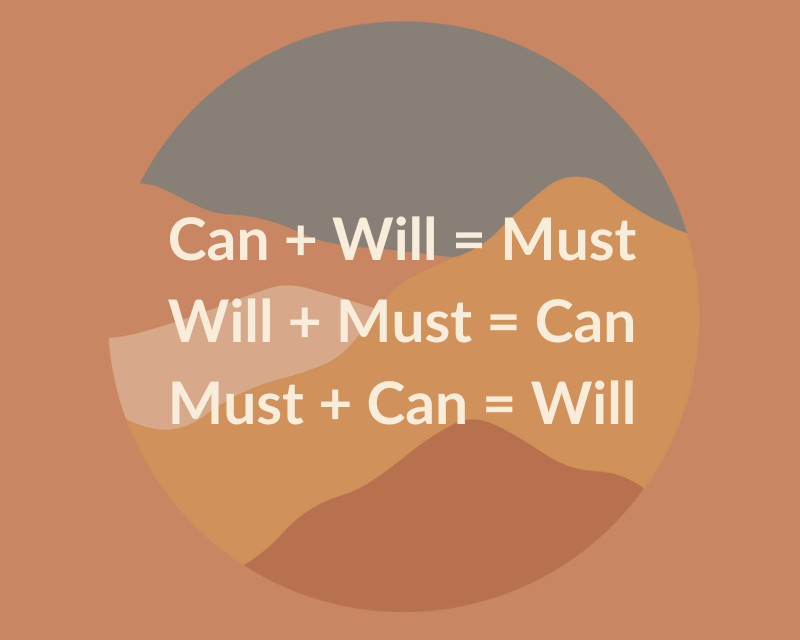
Clear enough? No? Let me explain! If you need to make a decision about something you feel unsure of, refer to this method and it will give you the push forward you need to move out of your current position and forward to your decision.
Can + Will = Must -> If you Can and you Will, then you Must. There are no if’s or but’s about it. Go! You must do it.
Will + Must = Can -> If you Will and Must, then you Can. There is nothing you can’t do when you both want to and must do it. You can do it.
Must + Can = Will -> If you Must and Can, then you Will. This one is particularly useful when coming across uncomfortable or undesirable decision-making, because it reframes the situation from a “I don’t want to”, to “I have to and I can do it, so I will go do it”. You just took control back from a situation that previously could have felt like it dictated your situation and made it entirely your own. You will do it.
And as a little bonus motivation to keep the momentum going from your decision-making process: Commit to your decision. Once you have decided, commit to making it a success. It will absolutely be a success, because you committed to making it one.
Now you have a clear direction, you have the motivation and the determination, and you have the goal for your decision-making outcome. It’s a simpler and less time consuming process to effectively come to a decision and avoid decision fatigue.
This one is of my own making, but has helped me countless times when fast decision-making is needed and the self-doubt comes sneaking in. It helps keep the doubting voices silent and the confident ones loud. Also, please use this method with a strong moral and ethical compass. And always with the intention to not do harm. I feel like that needs to be said, somehow.
3. What Would Beyoncé Do?
For the third and final step, you can always trust the good Queen Beyoncé to help you out here. This one is for when the sh*t has hit the fan, it is all blowing up, things are coming at you from right and left, and there is nowhere to hide, to take time, to think. You default to “What would Beyoncé do?” and you gain back your focus, your badass decision-making power, and you go deal with all of it – flawlessly.

Not what you expected to hear? Think back on her Lemonade era, think back to what she went through then, before and since and how she has meticulously channeled all of that energy into her determination to become and be Queen Bee. Think of the simple yet powerful notion “best revenge is your paper”. Think of the $440M empire she has built with that determination to succeed.
Now, think back on the decision-making you need to make right now as chaos has erupted and everyone is looking to someone (you) for direction. What would Beyoncé do? She would get sh*t done. And she would make damn sure no stone was left unturned for opportunity building. You now have your starting point and a rooted place from which you can run the world. No decision fatigue here.
Creating Clarity In Chaos Is A Skill All Marketers Need
Decision-making doesn’t have to be a heavy, paralyzing process. Whether you’re navigating a high-stakes strategy or need to build the plane while flying, the ability to choose with clarity is a muscle you can train. What these three models – The Renovator’s Delight, the Can/Will/Must method, and a little Beyoncé-inspired bravado – have in common is that they give you structure, momentum, and permission to trust your instincts.
What’s powerful about frameworks like these is how they reframe uncertainty as opportunity. Instead of spiraling in ambiguity, you start from a place of ownership: What do I already know? What do I want to protect? What is non-negotiable? These are the grounding questions that pull you out of fatigue and into focused, confident decision-making.
And when in doubt, especially when the pressure’s on, remember that bold decisions don’t require perfection. They require presence. They require trust in your experience, your values, and your vision. You’re not here to make every decision perfectly – you’re here to keep moving forward, with purpose.
The best marketers I have worked with have all owned in on this skill and leveraged it to achieve their goals, whether personal or professional. We each have our own clichés that make sense to us, and now you know of mine. In times of calm and chaos, they keep us moving forward. They are a cornerstone in the decision-making processes that allow us to choose momentum over hesitation.
Thank you for reading my blog. If you need help with building a high-impact, scalable marketing strategy, let’s talk. I can advise, consult or create for you. Contact me here and let’s have a conversation about how I can help you build your momentum.






 Momentum Marketing